M. S. Tillacka and S. Malangb
Abstract -- A novel blanket concept is described. The proposed design is a dual coolant concept based on ferritic steel as structural material using helium to cool the first wall. The temperature of the entire steel structure is maintained below the 550°C limit. The breeding zone is cooled by circulating the liquid metal breeder to external heat exchangers. Flow channel inserts are employed in the poloidal liquid breeder ducts, serving both as electrical and thermal insulator between the flowing liquid metal and the steel structure. In this way, a liquid metal exit temperature of about 700°C is achievable, allowing either an advanced Rankine steam cycle or a closed-cycle helium gas turbine (Brayton cycle) as power conversion system. A gross thermal efficiency of about 45% can be achieved with either system.
Self-cooled lithium blankets with vanadium alloy as structural material allow for both high power density and high temperatures leading to high efficiency. However, they are generally ruled out for safety reasons if water is used in other components of the machine. For example, this causes a dilemma for a Low Aspect Ratio (LAR) tokamak employing a water-cooled centerpost. Safety concerns could be overcome by using the eutectic lead lithium alloy Pb-17Li instead of lithium. However, the heat transport properties as well as the compatibility with ferritic steels and vanadium alloys for this liquid metal are not as good as with lithium.
Giancarli et al. [2], proposed a self-cooled PbLi blanket based on a SiC/SiC composite as structural material. The electrical resistance of this composite material, which is basically a semiconductor, is expected to be high enough to keep the MHD pressure drop within tolerable limits.
The major issues not yet resolved for such a blanket concept include:
Most of these problems are avoided with the blanket concept described in this paper. The proposed design is a dual coolant concept similar to the one described in [3], based on ferritic steel as structural material using helium to cool the first wall. The temperature of the entire steel structure is maintained below the 550°C limit. The breeding zone is cooled by circulating the liquid metal breeder to external heat exchangers. Flow channel inserts are employed in the poloidal liquid breeder ducts, serving both as electrical and thermal insulator between the flowing liquid metal and the steel structure. In this way, a liquid metal exit temperature of about 700°C is achievable, allowing either an advanced Rankine steam cycle or a closed-cycle helium gas turbine (Brayton cycle) as power conversion system. A gross thermal efficiency of about 45% can be achieved with both systems.
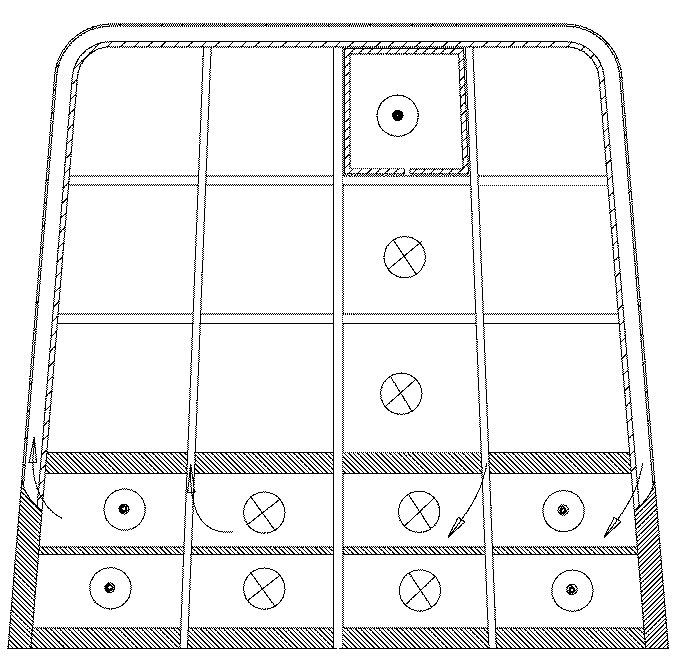
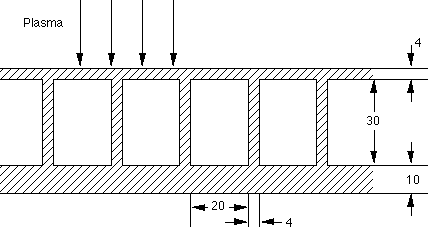
A cross section of the blanket segment is shown schematically in Fig. I. The concept is characterized by a U-shaped first wall (FW) with helium cooling channels oriented in the radial/toroidal direction. This FW forms, together with the helium manifolds at the back side of the segment, a box containing the liquid metal breeder. A grid of steel plates inside this box creates large liquid metal ducts and, as an additional function, reinforces the FW box. Inside all liquid metal ducts, which are oriented in the poloidal direction, there are flow channel inserts made of silicon carbide. These inserts serve as electrical as well as thermal insulators between the flowing liquid metal and the steel structure. In addition to the first wall, the grid plates also are cooled by helium in order to keep the steel structure below 550°C. The Pb-17Li enters the blanket at the bottom, flows upwards in the front row of parallel ducts, turns around at the top by 180° and flows down in the two parallel rows at the rear side of the blanket. The FW box is fabricated by diffusion welding and subsequent bending of the straight plates containing the milled coolant channels. A cross section of the FW is shown in Fig. II. The grid plates with smaller coolant channels are similar and also fabricated by diffusion welding.
The incoming helium at 350°C first cools the FW and then the grid plates, where it is heated up to 500°C. The helium flow is subdivided into two completely independent systems. The cooling channels in the FW as well as those in the grid plates are alternatively connected to one of the two systems in order to minimize the FW temperature increase in case of a Loss of Coolant Accident (LOCA) in one of the systems. Another benefit of the alternating flow directions is the more equal temperature distribution in the entire segment, resulting in lower thermal stresses.
The selected design of the helium cooling system is characterized by the following features:
A. Design Parameters
Parameters have been assumed for a preliminary layout of the blanket system. These parameters are summarized in Table I. First wall dimensions, grid plate dimensions, cooling channel size and spacing of the grid plates were estimated based on maintaining acceptable mechanical stresses in the structure in case the segment is pressurized to the full He pressure (plus static pressure of Pb-17Li) in the event of of a LOCA. The geometric design parameters are indicated in Figs.II and III.
Table I
Parameters Assumed for Thermal-Hydraulic
Analysis
| Average neutron wall load | 4 MW/m2 | |
| Average first wall heat flux | 0.8 MW/m2 | |
| Total energy multiplication in the blanket | 1.4 | |
| Radial depth of the breeding zone | 0.75 m | |
| Toroidal width of a segment | 1 m | |
| Height of the blankets | 20 m | |
| Helium pressure | 8 MPa | |
| Helium inlet/FW outlet/blanket outlet temperature | 350 / 420 / 500°C | |
| Pb-17Li in/outlet temperature | 480°C / 700°C |
B. Segment Power Distribution and Flow Rates
One segment of the blanket is assumed to be 1 m wide by 20 m high
(representative of a highly-elongated plasma as found in LAR tokamaks).
Therefore, with 4 MW/m2 average neutron wall loading, the total
volumetric heat generation is 112 MW. In the absence of detailed neutronics
analysis, we assume the power deposition is roughly proportional to the volume
fractions, so that 100 MW is deposited in the PbLi and 12 MW in steel. With
0.8 MW/m2 average surface heat flux, an additional 16 MW is
deposited in the FW. For the estimation of the heat fluxes through the 10 mm
thick insulator plates the material properties listed in Table II are used.
The power distribution results shown in Table III require the coolant flow
rates listed in Table IV.
Table II
Thermal Properties Used in the Analysis
| Steel conductivity | 25 W/m-K | |
| web thickness | 4 mm | |
| Pb-17Li conductivity | 15 W/m-K | |
| thickness | 3.5 mm | |
| SiC conductivity | 4 W/m-K | |
| thickness | 10 mm | |
| He heat transfer coefficient | 2000 W/m2-K | |
| Pb-17Li heat trans. coefficient | 1000 W/m2-K | |
| He heat capacity | 5200 J/kg-K | |
| PbLi heat capacity | 190 J/kg-K |
Table
III
Power Distribution in Blanket Segment (MW)
| Volumetric Heating | 112 | |
| in Pb-17Li | 100 | |
| in SS | 12 | |
| Surface Heating | 16 | |
| Heat Removed in He | ||
| Surface heat | 16 | |
| Volumetric heat in SS | 12 | |
| Heat transferred from PbLi | 7 | |
| TOTAL | 36 | |
| Heat Removed in PbLi | ||
| Volumetric heat in SS | 100 | |
| Heat transferred to He | -7 | |
| TOTAL | 93 | |
| Total Segment Power | 129 |
Table IV
Coolant Flow Rates
| Inlet He density | 6.16 kg/m3 | |
| Inlet He volume flow rate | 8.3 m3/s | |
| Outlet He density | 4.97 kg/m3 | |
| Outlet He volume flow rate | 10.3 m3/s | |
| PbLi volume flow rate | 0.25 m3/s |
The mass flow rate of PbLi required to remove 100 MW of power is 2400 kg/s. Using a mass density of 9500 kg/m3, the corresponding volume flow rate is 0.25 m3/s. This leads to a PbLi velocity of 1.5 m/s in the four parallel channels in the front row.
C. Coolant Access Tubes
A characteristic feature of Pb83Li17 is its low tritium
solubility. The resulting high tritium partial pressure can lead to
intolerably high tritium permeation losses from the coolant access tubes and
therefore generally requires additional permeation barriers. Another issue is
the material for the outlet tubes for a PbLi temperature of 700°C. There
is no steel available allowing a temperature above 600°C. To solve both
problems, it is suggested to use concentric access tubes with the liquid metal
flowing in the inner tube and helium in the annular gap. In this way helium
with a temperature of 500°C cools the liquid metal duct, especially if a
thermal insulator is arranged inside the liquid metal tube. 15-mm thick SiC is
proposed for this purpose. This design allows the use of steel for all access
tubes. Tritium from the Pb-17Li in this case will not enter the building
atmosphere but rather the helium coolant, where it can be recovered easily.
The heat is removed from the blanket by two systems:
This heat source can be used either for a Rankine cycle (steam turbine) or for
a Brayton cycle (closed-cycle gas turbine). A gross thermal efficiency of at
least 45% can be achieved with both power conversion systems based on the
temperatures listed above. A closed cycle helium gas turbine process is chosen
as a reference concept for the following reasons:
A total compression ratio of ~3 is required to allow for the relatively low
helium temperature of 350° C. The temperature differences available in
both systems will result in reasonable small heat transfer surface areas in
both types of heat exchangers. For the case here having two different heat
sources (He and Pb-17Li loops), a two stage lHX is required.
Furthermore, the high PbLi temperature of 700°C greatly enhances tritium
extraction because at this temperature tritium is much more mobile than at
450°C typical for water-cooled blankets. At this time, no attempt has
been made to select a suitable extraction method. This must be done together
with the selection of design and materials used for the heat exchanger.
For self-cooled Pb-17Li blankets with a flow velocity of up to 2 m/s and
ferritic steel as structural material, a maximum allowable interface
temperature of 470°C has been chosen, based on a corrosion rate of less
than 20 µm/year. It is assumed that a limit about 50°C higher
can be allowed in the stagnant gap. If the corrosion at this temperature turns
out to be too high or if thermal analyses show a higher interface temperature,
the helium exit temperature can be lowered from 500°C to 460-480°C
without causing large disadvantages.
No serious feasibility issues have been identified, but a number of
uncertainties remain. Potential problems are the impact of SiC on tritium
breeding, the compatibility of SiC with flowing Pb-17Li and the corrosion of
ferritic steel in stagnant Pb-17Li which may require a reduction of the helium
exit temperature. Other issues include the selection of a suitable tritium
extraction system and selection of suitable materials for the heat
exchanger.
[2] L. Giancarli, et al., "Design Requirements for SiC/SiC Composites
Structural Material in Fusion Power Reactor Blankets," ISFNT4 (to be published
in Fusion Eng. and Design).
[3] S. Malang, M.S. Tillack (ed.), Development of Self-Cooled Liquid metal
Breeder Blankets", FZK-report, FZKA 5581, Nov.1995
[4] L. A. El-Guebaly, private communication.
The tritium production in one segment with a total generated power of 140 MW is
estimated to be 20 g/day. The liquid metal flow rate in one segment is 2400
kg/s. This means that the tritium concentration in the liquid metal is
increased by about 0.1 wppb during one pass through the blanket. In a
water-cooled blanket, the situation is completely different. There the liquid
metal inventory is usually circulated 10 times per day. This means the tritium
concentration increases by 20 wppb during one pass. This is a factor of 200
times higher than in the case of self-cooling where a bypass flow of about 0.5%
would be sufficient if the same tritium concentration is tolerable. A higher
bypass ratio would lead to a lower partial tritium pressure compared to a
water-cooled Pb-17Li blanket.
All of the numbers in this paper are rough estimates based on extrapolated
values from similar concepts and partly on educated guesses. Thermal-hydraulic
and thermal-mechanical analyses are particularly required to verify the
dimensions chosen. Independent of the outcome of such analyses, the following
more general issues should be addressed:
The blanket design proposed here can be used in tokamaks with water-cooled
components because the Pb-17Li breeder material reacts only very mildly with
water in case of leaks. The use of ferritic steel structural material with SiC
inserts allows an average neutron wall load up to 4 MW/m2, and can
lead to a gross thermal efficiency in the power conversion system of about 45%.
With a liquid metal exit temperature of 700°C, either a Rankine cycle with
a steam turbine or a Brayton cycle with a helium gas turbine can be used.
The helium-cooled first wall allows a surface heat flux up to 0.8
MW/m2 without exceeding a temperature limit of 550°C. High
thermal conductivity is not required for the SiC, which serves as a thermal and
electrical insulator only, without any mechanical load carrying functions.
SiC, with an electrical resistance between that of steel and alumina, is not a
real insulator but leads to a tolerable MHD pressure drop without requiring
insulating coatings.
[1] F. Najmabadi and the ARIES Team, "Overview of the ARIES-RS Reversed-Shear
Tokamak Power Plant Study," to be published in Fusion Eng. and
Design.