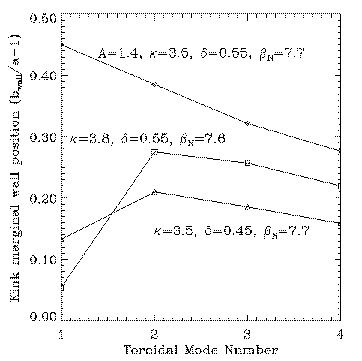
Fig. 1. All low-n kink modes are stabilized by decreasing K or increasing d, for fixed boundary A=1.4 ST equilibria.
T.K. Mau,a S.C. Jardin,b C.E. Kessel,b
J. Menard,b
Y.R. Lin-Liu,c R.L. Miller,c P.
Politzer,c R.D. Stambaugh,c W.P.
Westc
aFusion Energy Research Program, UC-San Diego, 9500 Gilman
Drive., La Jolla, CA 92093-0417
bPrinceton Plasma Physics
Laboratory, Princeton, NJ 08543-0451,
cGeneral Atomics, San Diego,
CA 92186-9784
Abstract -- ARIES-ST, a fusion power plant design based on the spherical tokamak concept, has many attractive features, including high beta and power density, low magnetic field, high self-driven current, and a compact power core. The physics basis for three aspects of the plasma performance and operation, namely, MHD stability, current drive and profile control, and startup have been investigated during the first phase of the design, and the results to date are reported.
The recent success of the START experiment [1] has spurred great interest in the concept of the spherical tokamak (ST) [2] as a power plant and volumetric neutron source. Since the beginning of 1997, the ARIES Group has embarked on the design of ARIES-ST [3], a commercial fusion power plant based on this concept. This device will have attractive features such as very high plasma b (~50%), low magnetic field (~2 T on axis), high self-driven current fraction (>95%), and a compact fusion power core.
For the ST-based fusion power plant to be economical, several engineering and physics issues must be addressed. Because of the lack of room for substantial shielding on the inboard side, normal conducting TF coils need to be used, resulting in large resistive losses and large recirculating power. The negative effect on the plant cost can be partially offset by operating at equilibria with intrinsically large plasma b. On the other hand, these equilibria may also have a well-aligned pressure-driven current fraction of ~99%, leading to much reduced current drive (CD) power requirements. Combining these two requirements yields the following identity [4][5]:
where A is the aspect ratio, fbs is the bootstrap current fraction, Cbs~0.6 is a profile dependent constant, Kis the plasma elongation and bN=b/(Ip/aBo) is the normalized b. It is clear from this identity that raising bN and/or K is pivotal in increasing b and fbs simultaneously. To achieve near-unity fbs with good profile alignment requires detailed control of the current and density/pressure profiles. Maximizing the center TF coil cross-section area is crucial in minimizing the resistive losses, implying that there will not be room for an OH transformer in the center stack. Therefore, plasma startup without OH volt seconds will be a central issue for the the ST power plant operation.
This paper describes the present status of our investigation of the physics basis for the ST concept as an attractive power plant. The results from our studies are used in determining the optimum design parameters for ARIES-ST [6]. The paper is divided into three parts, each dealing with an important aspect of the performance and operations of ST plasmas Section II presents the results of detailed MHD studies of the plasma performance as a function of shape factors and aspect ratio. The requirements for current drive (CD) and profile control, and the search for appropriate techniques are outlined in Sec. III. This is followed by Sec. IV on a proposed scheme for plasma and current startup without the use of an OH transformer. In Sec. V, we summarize our findings to date, and discuss work to be performed to complete the study.
II-A. MHD Stability:
To map out the optimum operating regimes for ARIES-ST, we have carried out an extensive study of the MHD stability limits of ST configurations, and their dependence on aspect ratio, and plasma shape. In particular, we have studied the ballooning stability limits of fixed-boundary equilibria with 99% pressure-driven currents, with A=1.25-2.0 and with K=1.6-2.8 at triangularity values of d=0.45 [4]. We find that bN increases with increasing K up to 2.8, and that bN at K=2.8 is a maximum of 7.7 at A=1.4, and then decreases to about 7.0 at A=2.
We have also studied the kink stability as a function of K and d at A=1.4. We find that all equilibria of interest need a conducting wall with a plasma-wall separation less than 0.5a where a is the average plasma minor radius. As shown in Fig. 1, the wall separation requirements are typically most severe for intermediate toroidal mode numbers n of about 5 or more. Decreasing K or increasing d are both stabilizing for all low n modes. For very high elongation, the n=1 external kink mode limits the maximum stable K, which increases from about 3.5 to 3.8 as d increases from 0.45 to 0.55.
For the systems code analysis, we have identified three configurations at differing aspect ratios that are all at marginal stability to the external kink, set by the n=6 mode, with the critical plasma-wall separation at 0.2a. These are all stable to ballooning, and have pressure-driven current fraction of over 99%. Their parameters are listed in Table I.
At A=1.6 and K=3.2, as d is decreased from 0.57 to 0.35, the ballooning marginal [beta] decreases about 20% and the critical wall separation decreases about 40%. At A=1.6 and d=0.35, with a wall separation distance approaching the d=0.57 value, the stable beta drops from 40% to less than 25%.
Fig. 1. All low-n kink modes are stabilized by decreasing K or increasing d, for fixed boundary A=1.4 ST equilibria.
Parameters for ARIES-ST Equilibria
| A | K | [delta] | [beta]N | [beta](%) |
| 1.4 | 3.4 | 0.55 | 7.75 | 55.6 |
| 1.6 | 3.2 | 0.57 | 7.00 | 39.8 |
| 1.8 | 3.0 | 0.57 | 6.55 | 31.1 |
II-B. Free-Boundary Equilibria
We have also developed and applied a free-boundary equilibrium code for the ARIES-ST project to determine (i) the PF coil locations and currents, (ii) the poloidal flux topology for the divertor design, and (iii) the feasible plasma parameters and plasma shape combinations. These equilibria present special challenges for several reasons. The fact that there are no PF coils on the inboard side of the plasma makes it especially difficult to control the innermost boundary points of the equilibria. The desire to obtain equilibria with high poloidal beta but with low internal inductance implies high-order cancellations in the plasma equilibrium equation that are possible only for a special parameterization of the profiles. Also, the strong shaping required for ideal MHD stability has to be obtained in the presence of strong natural shaping from the plasma interacting with its own self fields.
To this end, we have modified the free-boundary equilibrium calculation in TSC [7] to utilize a formulation of the plasma toroidal current in which the pressure p([psi]) and the parallel current function, <J.B>/<B2>(j) are the inputs. The resultant calculations are successful but time-consuming, since magnetic surface averages of <B2> must be calculated at each stage of the equilibrium iteration.
In these initial calculations, we have used a set of 26 poloidal field coils located outside of the region occupied by the toroidal field coils. The optimal coil currents were determined using the Singular Valued Decomposition technique. We list the parameters of 3 typical equilibria of interest for ARIES-ST optimization studies in Table-II:
| A | li | bp | K | d |
| 1.4 | 0.16 | 1.73 | 3.4 | 0.52 |
| 1.6 | 0.18 | 1.83 | 3.2 | 0.52 |
| 1.8 | 0.18 | 1.83 | 3.1 | 0.50 |
The equilibria listed are all diverted, and an interesting common feature is that the inboard plasma boundary is very nearly vertical. . We can also find limiter free-boundary plasma equilibria by reducing the shaping. Equilibria that are technically limited but that have a nearby separatrix may also be of interest since some splitting of the heat flux may then be possible. We are currently optimizing these solutions with respect to the number of PF coils and their currents.
Our studies indicated that stable ST equilibria exist that have both high b and pressure-driven current fraction of ~99% with the appropriate plasma profiles. In addition, this self-driven current profile is well-aligned to the equilibrium profile, requiring only a tiny amount of seed current on-axis to be driven externally. An example of this type of equilibrium is shown in Fig. 2, where A=1.6, K=3.20, d=0.57, bN=7.0, b=39.7% and the pressure-driven current fraction is 99.1%. This equilibrium is stable to ballooning and n=1-6 kink modes with a conducting wall.
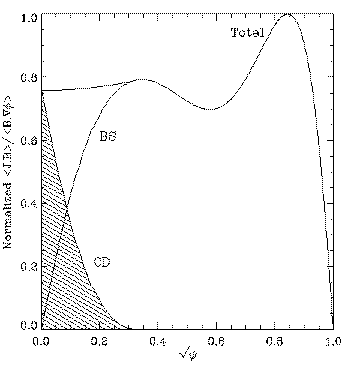
Fig. 2. Typical A=1.6 ST equilibrium with ~99% pressure-driven current fraction and good profile alignment.
Although there have been indications that the self-driven current might be non-zero on axis, we adopt the prudent position that a modest power level be set aside for seed CD and profile control so as to maintain the optimum equilibrium. We attempt to identify noninductive techniques that drive currents on axis, off axis and near the edge.
The possibilities of driving the on-axis seed current with radiofrequency (RF) techniques have been independently investigated [8]. In the high end of the frequency spectrum, electron cyclotron waves are ruled out because, at (fpe/fce)2>>1, they will encounter cutoff before reaching the core. For the same parameter range, there will be no window in the N|| spectrum for the lower hybrid waves to penetrate to the magnetic axis.
With regard to the fast wave, we look at scenarios that avoid or minimize ion cyclotron absorption in the plasma cross section. In Fig. 3, the lower ion cyclotron harmonic frequencies together with the DT hybrid resonance are shown along the plasma midplane for the A=1.6 ST equilibrium with Bo=2.6 T. Because of the non-monotonic dependence of the magnetic field strength with R, the major radius, there are only two wndows in frequency for on-axis drive via electron absorption: (i) low frequency fast wave (LFFW): f<9.0 MHz, that avoids all ion resonances, and (ii) ICRF: f~26.5 MHz, that avoids ion resonances on the low field side. Current drive by high harmonic fast waves (HHFW) at f~20fci is planned on the NSTX experiment under construction at PPPL. According to our calculations [9] damping of this wave is so strong that penetration to the axis is possible only for low-b operation. Thus HHFW can only be considered for midplasma profile control at full b, and for core heating during part of the startup phase.
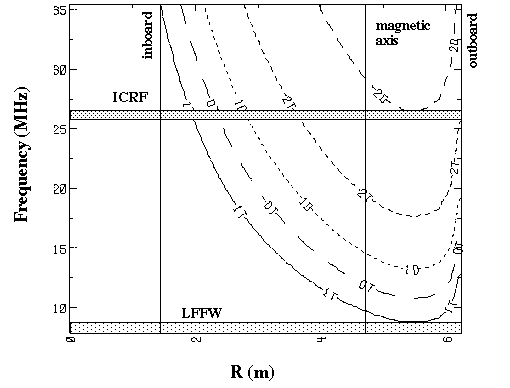
Fig. 3. Frequency windows for on-axis seed current drive using ICRF and LF fast waves, for A=1.6 ST equilibrium.
Using the CURRAY ray tracing code [9], we have demonstrated that LFFW is capable of driving currents on axis. In the case study using the A=1.6 equilibrium, we set f=8.5 MHz and N||=2.5, and launch the wave from above the outboard midplane. At a peak temperature and density of 20 keV and 2.62x10²⁰ m-3, respectively, we obtained a centrally peaked driven current profile with an efficiency of 0.015 A/W, which translates to a required CD power of 20 MW. The main issue with the LFFW CD scenario is the large size of the antenna structure, which is estimated to be ~14 m in toroidal width in order to launch the desired spectrum.
The ICRF scheme for current drive has also been examined in the same magnetic geometry. The result showed an off-axis driven current profile, most probably due to the strong damping related to the high plasma [beta]. Inclusion of the damping by energetic [alpha]-particles will further impede the wave penetration. Therefore this technique has not received further consideration.
Space limitation in the center column of the spherical tokamak makes it necessary to consider a plasma startup process without the OH transformer in the design of ARIES-ST. In our preliminary investigation, we determine that bootstrap current overdrive is an attractive method for current ramp-up to its full value. However, to implement this scheme, an initial target plasma with a low level of plasma current must first be formed.
IV-A. Plasma Initiation
For plasma initiation with no central solenoid, one of the methods we have considered uses flux available from the divertor and outer poloidal field coils. DIII-D is well suited to a demonstration of this initiation technique, and modeling has been done using the time dependent MHD code, DINA [10]. Figure 4 shows the results of modeling of a plasma current ramp from 20 kA to 200 kA in DIII-D using only these types of coils. In this case, to provide the required volt seconds, currents in selected divertor coils are ramped downward in one direction. The total volt-second swing achieved, including some contribution from an outer PF coil during a compression phase, is about 1 VS.
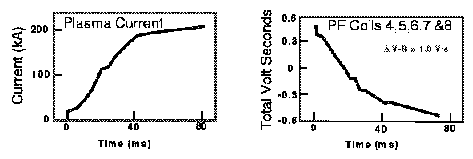
Fig. 4. Modeling of plasma current ramp-up from 20 kA to 200 kA using DIII-D divertor and poloidal field coils.
Several key issues have come to light in the process of this modeling. First, the required pre-bias of the divertor coils results in a relatively poor null prior to the breakdown of the plasma. This problem can most likely be overcome using RF assisted breakdown. Second, in the early phase of the plasma current ramp, the plasma shape tends to be highly elongated. Care must be taken to ensure vertical stability. Third, the current swing in the divertor coils needed to produce the volt seconds results in a final plasma shape that has an elongation below 1. Although in this case radial stability appears to be good, the next phase of the noninductive plasma current ramp must not only take the plasma current up to the required level (perhaps several MA), but must also overcome the back emf produced when the currents in the divertor coils are returned to the positive levels required for elongation.
IV-B. Current Ramp-Up
The concept of using the bootstrap current overdrive to ramp up the plasma current was recently proposed [11]. The overdrive scenario is obtained by selecting a target plasma with sufficiently low Ip and high enough bp such that the bootstrap current, Ibs , exceeds Ip and provides the emf for ramping up the plasma current. Non-inductive driven current will be needed for regulating the plasma current near the magnetic axis where the bootstrap current vanishes. The current ramping rate is determined by the skin time, t o (~Te3/2), and the amount of excess Ibs , which is proportional to Te for a collisionless plasma with a density close to the Greenwald limit. It is found that the ramp rate maximizes at dIp/dt=2Ip/t o when Ibs=3Ip .
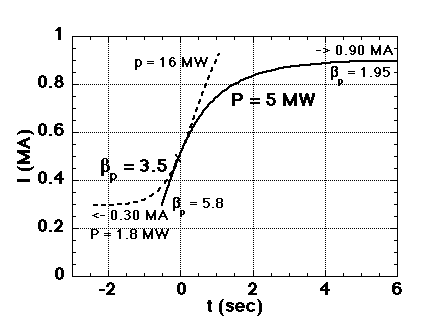
We have so far performed 0-D simulation of two scenarios for bootstrap ramp-up in the context of a possible ST experiment [12], with R=1.23 m, a=0.88 m, and K=3. One involves a constant p p ramp-up, and the second assumes a constant input power. The plasma density is allowed to ramp up with current to maintain a constant ratio of 0.8 to the Greenwald density limit. The results are highlighted in Fig. 5. The dashed line gives the current vs. time when the power is adjusted to maintain p p=3.5. Using the ITER89p (L-mode) confinement scaling with an H-factor of 2, the required auxiliary heating power has been estimated to be P=1.8 MW at Ip=0.3MA and P=16MW at Ip=0.9MA. In the constant heating power scenario , the result for P=5 MW is given by the solid curve in Fig. 5. Since for a given power input, p p is inversely proportional to Ip, the current eventually saturates at 0.9 MA It is useful to point out that, for startup in a power plant, the ramp-up time is not a crucial consideration, and there will be [alpha]-particle heating power available. These will be incorporated in future simulations for ARIES-ST.
The present status of our investigation into three areas of the physics basis for ARIES-ST has been highlighted. We have obtained three optimum stable equilibria at A=1.4, 1.6 and 1.8 for systems analysis. Free boundary calculations are being carried out to design the PF coil system for optimum plasma shaping and divertor configuration. LFFW current drive appears problematic for on-axis seed current drive because of the large antenna size, and neutral beam injection will be investigated as an alternative. The robustness of the equilibria around the design point and the requirements for current profile control are to be studied. The bootstrap overdrive plasma startup scenario with PF and divertor coil assist for plasma initiation has been analyzed for a future ST experiment with a 0-D code. This scenario will be assessed for ARIES-ST in the near future, while other noninductive plasma initiation schemes will be explored. Particle and heat removal issues will also be addressed in detail.
[1] A. Sykes, G.W. Crawford, G. Cunningham, et al., "The START Spherical Tokamak," Proc. 16th IEEE/NPSS Symp. on Fusion Engineering, Champaign/Urbana, Vol. 2 (1995) 1442.
[2] Y-K M. Peng and D.J. Strickler, "Features of Spherical Torus Plasmas," Nucl. Fusion 26 (1986) 769
[3] F. Najmabadi, "The ARIES Spherical Tokamak Power Plant Study," this Symposium.
[4] J.E. Menard, S.C. Jardin, S.M. Kaye, et al., "Ideal MHD Stability Limits of Low Aspect Ratio Tokamak Plasmas," Nucl. Fusion 37, (1997) 595.
[5] R.L. Miller, Y.R. Lin-Liu, A.D. Turnbull, et al., "Stable Equilibria for Bootstrap-Current-Driven Low Aspect Ratio Tokamaks," Phys. Plasmas 4 (1997) 1062.
[6] R.L. Miller, "Design-Point Determination for the Commercial Spherical
Tokamak, ARIES-ST," this Symposium
[7] S.C. Jardin, N. Pomphrey and J. DeLucia, "Dynamic Modeling of Transport
and Positional Control of Tokamaks," J. Comp. Phys. 66 (1986)
481.
[8] V.S. Chan, S.C. Chiu, Y.R. Lin-Liu, et al., "Current Drive and Profile Control in Low Aspect Ratio Tokamaks," 22nd EPS Conf. on Controlled Fusion and Plasma Phys., Bournemouth (1995) Vol. 19C, part I, 377.
[9] T.K. Mau and S.C. Chiu, "RF Current Drive Modeling for Spherical Torus Plasmas," AIP Conf. Proc. 403 (1997) 243.
[10] W.P. West, R. Khayrutdinov, V. Lukash, and D. Humphreys, "Modeling of Plasma Initiation and Current Rampup on DIII-D Using only the Divertor and Outer Poloidal Field Coils," Spherical Torus Workshop, St. Petersburg, Russia (1997).
[11] W.M. Nevins, private communication (1997).
[12] Y.R. Lin-Liu, R.L. Miller, V.S. Chan, et al., "High bp Equilibrium and Bootstrap Currrent Overdrive in Low Aspect Ratio Tokamaks," Spherical Torus Workshop, St. Petersburg, Russia (1997).