 (1)
(1)
Martensitic/Ferritic Cr-Mo steels are preferred to austenitic stainless steels in fusion applications due to their lower swelling properties, higher thermal conductivity, lower thermal expansion and better liquid-metal compatibility.
The EU technology program started by concentrating on a limited number of steels namely Manet (1.4914 type) and an optimization program was started to improve the steel for fusion purposes. Chromium and carbon content was reduced to minimize radiation-induced precipitation and improve welding. Nitrogen was added to compensate for the loss of strength caused by the reduction of carbon. Low specification levels were set for phosphorus and sulphur to eliminate anisotropic impact properties, and zirconium was added to reduce the effect of sulphur on toughness.
An early concern for ferritic steels involved the magnetic forces arising from their ferromagnetic nature in the presence of magnetic fields. Design studies indicated that stresses by magnetic forces must be accounted for, but can be managed, refs [1, 2]. Work on martensitic/ferritic steels for fusion has involved studies of the effect of irradiation on swelling, microstructure and mechanical properties, ref [3].
Irradiation effects
Displacement damage is the disposition of the vacancies and interstitials formed by high-energy neutrons. The effect of irradiation on the tensile behavior of martensitic/ferritic steels depends on temperature. An increase in yield stress occurs at irradiation temperatures up to 425-450 C. This hardening is caused by the high density of dislocation loops and tangles that form in the material together with irradiation-induced precipitate changes. Irradiation hardening saturates with fluence when hardening is due to displacement damage and saturates at a higher level when displacement damage and helium are co-produced.
Certain irradiated alloys that contain helium develop large ductility decreases after irradiation at a temperature T>0.6Tm, with Tm the melting temperature. This elevated temperature helium embrittlement is caused by intergranular fracture and the loss of ductility is caused by helium on grain boundaries.
Isothermal fatigue behavior has been studied under strain-controlled conditions from 20-650 C by the EU program. Results indicate that the temperature dependence of the number of cycles to failure, Nf is not very pronounced. Also in comparison to austenitic steels there is only a small reduction of Nf with decreasing strain rate.
In relation to the He/dpa ratio, studies showed that for damage levels of a few dpa and several hundred appm He (<400 appm), the isothermal fatigue behavior is not essentially changed from 20-450 C. Radiation hardening occurs below ~400 C and at higher temperatures irradiation enhances recovery. Recent investigations on the effect of hold times on isothermal fatigue of Manet pre-implanted with high helium amounts confirm this general trend [4].
Martensitic/ferittic steels show good compatibility with liquid lithium and Pb-Li eutectic. Studies indicate that ferritic steels corrode more slowly than austenitic stainless steels, ref [5].
GENERAL PROPERTIES - MANET
Chemical analysis of Manet (1.4914 type steel)
   C     Cr       Ni       Mo       V        Nb       Si       Mn       B        N
 0.13    10.6     0.87     0.77     0.22     0.16     0.37     0.82     0.0085   0.020
Physical properties
Melting temperature interval : ~1450 - 1530 C
Heat of fusion : 64.5 Cal/g
Heat of vaporization : 1780.7 Cal/g
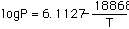
Vapor pressure P :
(1)
where the pressure P is in atm and temperature T in Kelvin.
Density [[rho]] (kg/m3) :
 (2)
(2)
Coefficient of thermal expansion [[alpha]] (m/m-K) :
 (3)
(3)
Thermal conductivity k (W/m-K) :
 (4)
(4)
Specific heat c (J/kg-K) :
 (5)
(5)
DATA AND CORRELATIONS
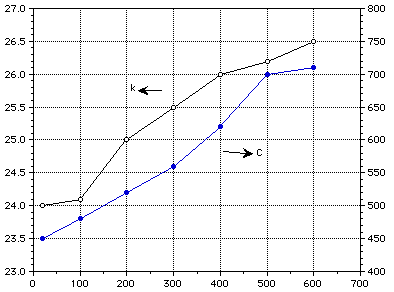
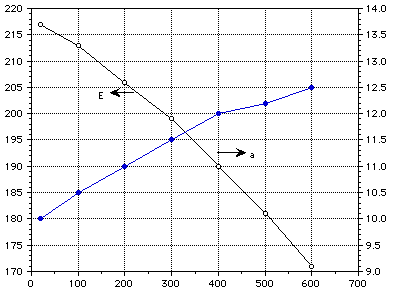
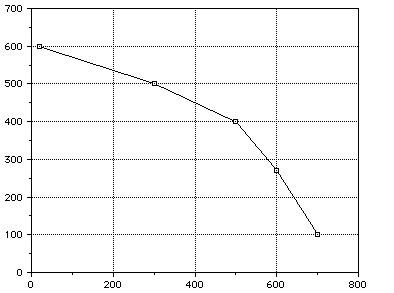
The thermal and structural properties as a function of temperature are presented in Table 1, ref [6]. Polynomial correlations of the thermal and structural properties as functions of temperature, using the data of Table 1, are as follows:
 (6)
(6)
 (7)
(7)
 (8)
(8)
 (9)
(9)
 (10)
(10)
with T in degrees Celsius and Eqs 5-10 valid in the range 20-700 C. Fig 4 shows the creep stress to rupture master curve (Larson Miller Parameter) for Manet, ref [7]. A polynomial fit to the data is as follows:
 (11)
(11)
               TABLE 1 Thermal and structural properties of MANET
   T C     [[rho]]    E GPa      [[nu]]     k W/m-K    C J/kg-K   [[sigma]]  [[alpha]]
           kg/m3                 ---                              y MPa      (10-6)
                                                                             m/m-K
   20      7700.0     217.0      0.300      24.00      450.00     600.000    10.000
   100                213.0                 24.10      480.00     560.032    10.500
   200                206.0                 25.00      520.00     528.669    11.000
   300                199.0                 25.50      560.00     500.000    11.500
   400                190.0                 26.00      620.00     461.810    12.000
   500                181.0                 26.20      700.00     400.000    12.200
   600                171.0                 26.50      710.00     270.000    12.500
   700                159.7                 26.83      965.27     100.000    12.671
k (W/m-K) c (J/kg-K)
Temperature (C)
Figure 1 : Thermal conductivity and specific heat of Manet.
E (GPa) [[alpha]] (10-6 m/m-K)
Temperature (C)
Figure 2 : Elastic modulus and coefficient of thermal expansion of Manet.
Yield Stress (MPa)
Temperature (C)
Figure 3 : Yield stress of Manet.
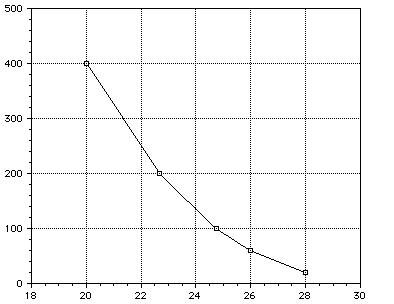
(P/1000)
Figure 4 : Creep-to-rupture stress variation with the Larson-Miller parameter.